

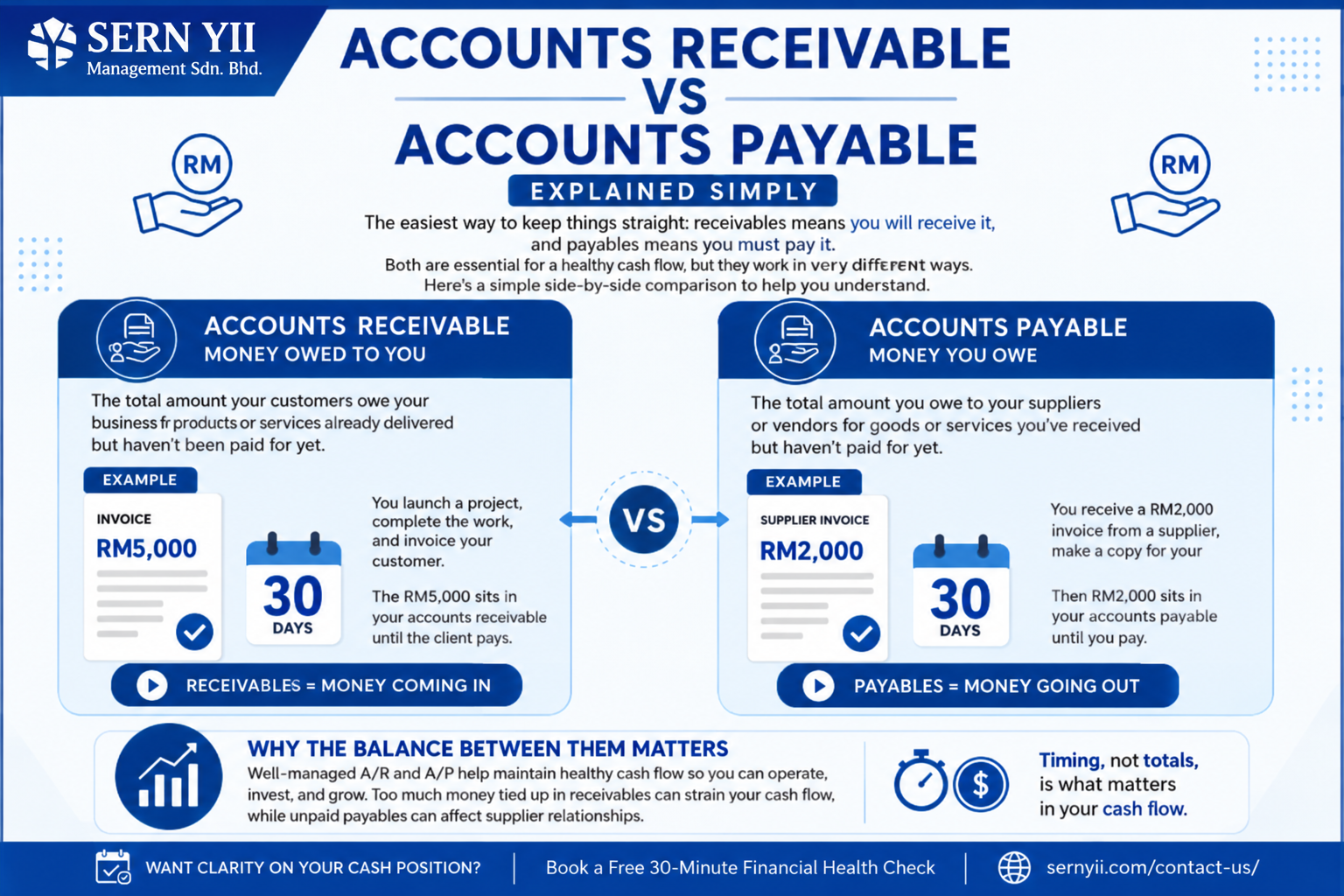
Accounts Receivable vs Accounts Payable — Explained Simply
If you’re new to reading your own books, accounts receivable vs accounts payable is usually one of the first pairs of terms that trips people up—not because the concept is complicated, but because the names sound so similar. Once you see the one-line distinction, though, it clicks immediately and stays clicked.
Here’s the plain-English version of both, with an example of each, and why the balance between them says more about your cash position than either number does on its own.
In This Article
- The one-line distinction
- Accounts receivable, explained with an example
- Accounts payable, explained with an example
- Why the balance between them matters
- How to manage each one well
- Frequently asked questions
Quick Answer: Accounts receivable is money owed to you by your customers. Accounts payable is money you owe to your suppliers. Receivable is money coming in; payable is money going out. Both represent real cash that hasn’t moved yet.
Accounts Receivable vs Accounts Payable: The One-Line Distinction
The easiest way to keep these straight: receivable means you will receive it, and payable means you must pay it. Both are amounts that have been agreed but not yet settled in cash—the difference is simply which direction the money is moving.
Because both sit in that in-between space—earned or owed, but not yet cash in hand—they’re exactly the kind of numbers that explain the gap covered in our piece on cash flow vs profit. A sale can be fully real on your books and still be sitting as accounts receivable for weeks before it actually reaches your bank account.
Accounts Receivable — Money Owed to You
Accounts receivable is the total amount your customers owe you for goods or services you’ve already delivered but haven’t been paid for yet. Say you’re a graphic design studio and you invoice a client RM5,000 for a completed project, with payment due in 30 days. From the moment you send that invoice until the client actually pays, that RM5,000 sits in your accounts receivable—it’s real revenue on your books, but it isn’t cash in your account yet.
Accounts Payable — Money You Owe
Accounts payable is the mirror image: the total amount you owe to your own suppliers or vendors for goods or services you’ve received but haven’t paid for yet. If your studio receives an RM2,000 invoice from a freelance illustrator with 30 days to pay, that RM2,000 sits in your accounts payable until you actually transfer the money. It’s a real obligation, but the cash hasn’t left your account yet either.
Why the Balance Between Them Matters
On their own, neither number tells you much. Instead, what matters is the relationship between the two — specifically, how quickly your receivables come in relative to how quickly your payables go out.
If your customers are paying you on Net 60 terms while your own suppliers expect payment on Net 30, you’re stuck funding that 30-day gap yourself, even though the business is fully profitable on paper. This mismatch is one of the quieter reasons a growing, profitable business can still feel constantly short on cash—the timing, not the totals, is the problem.
A business in a genuinely healthy position usually collects receivables faster than it needs to pay out payables, or at least keeps the two closely matched. When that timing flips the other way for an extended stretch, it’s worth treating as an early signal rather than waiting for it to become a full cash crunch.
How to Manage Each One Well
Because these are two different sides of the same cash flow gap, they benefit from two different habits:
- For accounts receivable: invoice promptly, set clear payment terms upfront, and follow up on anything overdue by 30 days rather than letting it drift
- For accounts receivable: consider offering a small early-payment discount to customers who consistently pay late—it’s often cheaper than the cash flow strain of waiting
- For accounts payable: negotiate payment terms with suppliers that better match how quickly your own customers typically pay you
- For accounts payable: don’t pay early out of habit—use the full term you’ve been given, since that cash is doing more good sitting in your account until it’s due
Once both are being tracked deliberately, the accounts receivable turnover ratio covered in our related post on financial KPIs becomes a genuinely useful monthly check, rather than just a number your bookkeeper mentions in passing.
A Quick Way to Measure How Well You’re Managing Receivables
One useful metric worth tracking alongside your accounts receivable balance is Days Sales Outstanding (DSO), which measures the average number of days it takes to collect payment after a sale. A lower DSO means cash is coming in faster; a rising DSO over several months is often the earliest sign that receivables are starting to slip.
The formula is simple: divide your accounts receivable by total credit sales, then multiply by the number of days in the period. A DSO of 30 means customers take about a month, on average, to pay—reasonable for standard 30-day terms. If that number starts creeping toward 45 or 60 without a change in your terms, it’s usually a sign collections need attention, not necessarily that customers have gotten worse.
Frequently Asked Questions
Are accounts receivable and accounts payable considered assets or liabilities?
Accounts receivable is an asset — it’s money owed to you, which you expect to collect. Accounts payable is a liability — it’s money you owe and are expected to pay.
What happens if accounts payable is consistently higher than accounts receivable?
It’s not automatically a problem — some businesses operate this way deliberately by negotiating longer supplier terms. But if it’s not intentional, it usually signals that outgoing obligations are growing faster than incoming cash, which is worth investigating before it becomes a shortfall.
Do very small businesses need to track these separately, or is a simple bank balance enough?
Even a very small business benefits from tracking both, because a healthy bank balance today can hide a large batch of payables coming due next week. Two simple running lists—who owes you and who you owe—are usually enough to start.
Want Help Getting on Top of Your Receivables and Payables? Book a free 30-minute financial health check with Sernyii at sernyii.com/contact-us/. We’ll help you set up a simple system to track both and keep the timing gap from catching you off guard.
Sources
http://www.wallstreetprep.com/knowledge/days-sales-outstanding-dso/
http://www.versapay.com/resources/what-is-dso-and-why-is-it-the-lifeline-for-accounts-receivable
http://ramp.com/blog/accounts-payable/trade-receivables-vs-accounts-receivable
http://en.wikipedia.org/wiki/Days_sales_outstanding
No responses yet