

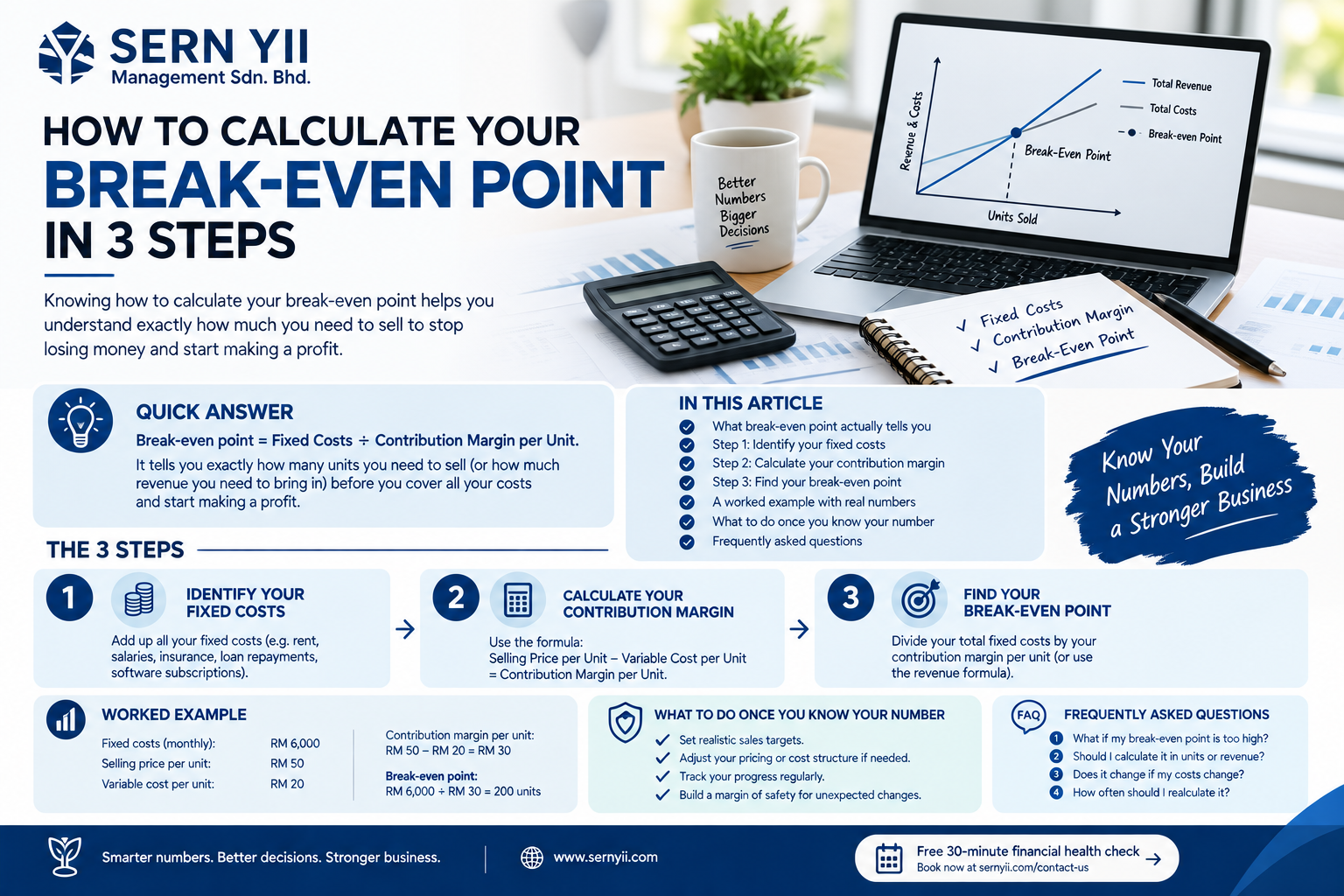
How to Calculate Your Break-Even Point in 3 Steps
Knowing how to calculate the break-even point is one of those things every business owner has heard of but few actually sit down and work out for their own business, usually because it sounds more complicated than it is. In reality, it’s three simple steps and a bit of arithmetic you can do on the back of an envelope.
Your break-even point is the exact amount of sales in units or in revenue where your business stops losing money and starts making it. Below is how to calculate it properly, with a worked example using real numbers.
In This Article
- What the break-even point actually tells you
- Step 1: Identify your fixed costs
- Step 2: Calculate your contribution margin
- Step 3: Find your break-even point
- A worked example with real numbers
- What to do once you know your number
- Frequently asked questions
Quick Answer: Break-even point = Fixed Costs ÷ Contribution Margin per Unit. It tells you exactly how many units you need to sell (or how much revenue you need to bring in) before you cover all your costs and start actually making a profit.
What Break-Even Point Actually Tells You
Before diving into the calculation, it helps to be clear on what this number is actually for. The break-even point tells you the minimum level of sales needed to cover every cost of running the business after that point, every additional sale contributes directly to profit.
This matters most before a big decision: launching a new product, hiring another staff member, signing a new lease, or setting a price. Because it replaces a gut feeling with an actual number, knowing your break-even point turns a hard-to-defend decision into a concrete target you can plan around and explain to a partner, lender, or co-founder.
Step 1: Identify Your Fixed Costs
Fixed costs are the expenses that stay the same regardless of how much you sell. Rent, salaries, insurance, loan repayments, and software subscriptions are common examples. Add these up for the period you’re measuring, typically a month.
Be thorough here. It’s easy to remember rent and forget smaller recurring costs like accounting fees or software subscriptions, but these all count toward the total your sales need to cover before you’re actually profitable.
Step 2: Calculate Your Contribution Margin
Contribution margin is what’s left from each sale after subtracting the variable cost of making or delivering that specific unit: ingredients, packaging, direct labour, payment processing fees, and similar costs that scale with each sale.
The formula is: Selling Price per Unit − Variable Cost per Unit = Contribution Margin per Unit. This is the amount each sale actually contributes toward covering your fixed costs, before anything becomes profit.
Step 3: Find Your Break-Even Point
With fixed costs and contribution margin in hand, the final step is a single division: Fixed Costs ÷ Contribution Margin per Unit = Break-Even Point in Units. Multiply that by your selling price to get your break-even point in revenue instead, if that’s more useful for how you think about the business.
A Worked Example With Real Numbers
Say you run a small café. Your monthly fixed costs rent, salaries, utilities, insurance total RM15,000. You sell coffee at RM12 each, and the variable cost per cup (beans, milk, cup, lid) is RM4.
- Contribution margin per unit: RM12 − RM4 = RM8
- Break-even point in units: RM15,000 ÷ RM8 = 1,875 cups per month
- Break-even point in revenue: 1,875 cups × RM12 = RM22,500 per month
This tells the café owner something concrete and immediately useful: sell fewer than 1,875 cups this month, and the business loses money. Sell more, and every additional cup after that RM4 variable cost goes straight to profit.
A Related Number Worth Knowing: Margin of Safety
Once you know your break-even point, one useful follow-up question is how much cushion you actually have above it. This is called your margin of safety, the gap between your current or expected sales and your break-even point, usually expressed as a percentage.
Using the café example: if the owner expects to sell 2,500 cups next month against a break-even point of 1,875, the margin of safety is (2,500 − 1,875) ÷ 2,500 = 25%. In other words, sales could drop by a quarter before the business tips back into a loss. A thin margin of safety is a signal to build a buffer before committing to new fixed costs; a wide one means there’s more room to take a calculated risk.
What to Do Once You Know Your Number
Your break-even point becomes far more useful once you start applying it to real decisions, rather than calculating it once and filing it away:
- Before launching a new product, calculate its own break-even point separately; don’t assume it will perform like your existing offerings
- Before hiring, add the new salary to your fixed costs and recalculate the new break-even point. It is your real target, not a guess
- When setting prices, test a few different price points through the formula to see how much each one shifts your break-even volume
- Revisit the calculation whenever a major fixed cost changes, like a rent increase, a new subscription, or an added headcount, since your break-even point moves every time
For a deeper look at the underlying accounting concepts, Corporate Finance Institute’s guide to break-even analysis is a solid next read once the basics here feel comfortable.
Once you’re comfortable with this calculation, it pairs naturally with the KPIs covered in our related post, particularly gross margin, since contribution margin and gross margin are close cousins that tell you related but distinct things about your pricing.
Frequently Asked Questions
Does the break-even point account for taxes?
No, the standard break-even formula works at the operating level, before tax. It tells you when you cover costs and start generating profit, not your after-tax position.
What if my business sells multiple products at different prices?
Calculate a weighted average contribution margin across your product mix, or run the calculation separately for each major product line if they have significantly different margins. The second approach is usually more useful for pricing decisions.
How often should I recalculate my break-even point?
Any time a major fixed cost changes, and at minimum once a quarter, even if nothing obvious has shifted, small increases in overhead add up without you noticing.
What’s the difference between break-even point and margin of safety?
The break-even point tells you the minimum sales needed to avoid a loss. Margin of safety, by contrast, tells you how much buffer you currently have above that minimum. The first is a floor; the second is how far you are from hitting it.
Not Sure What Your Break-Even Point Actually Is? Book a free 30-minute financial health check with Sernyii at sernyii.com/contact-us/. We’ll help you work out your real numbers and what they mean for your next big decision.
sources
http://corporatefinanceinstitute.com/resources/accounting/break-even-analysis/
http://sernyii.com/services/recordkeeping-services/
http://sernyii.com/contact-us/
No responses yet