

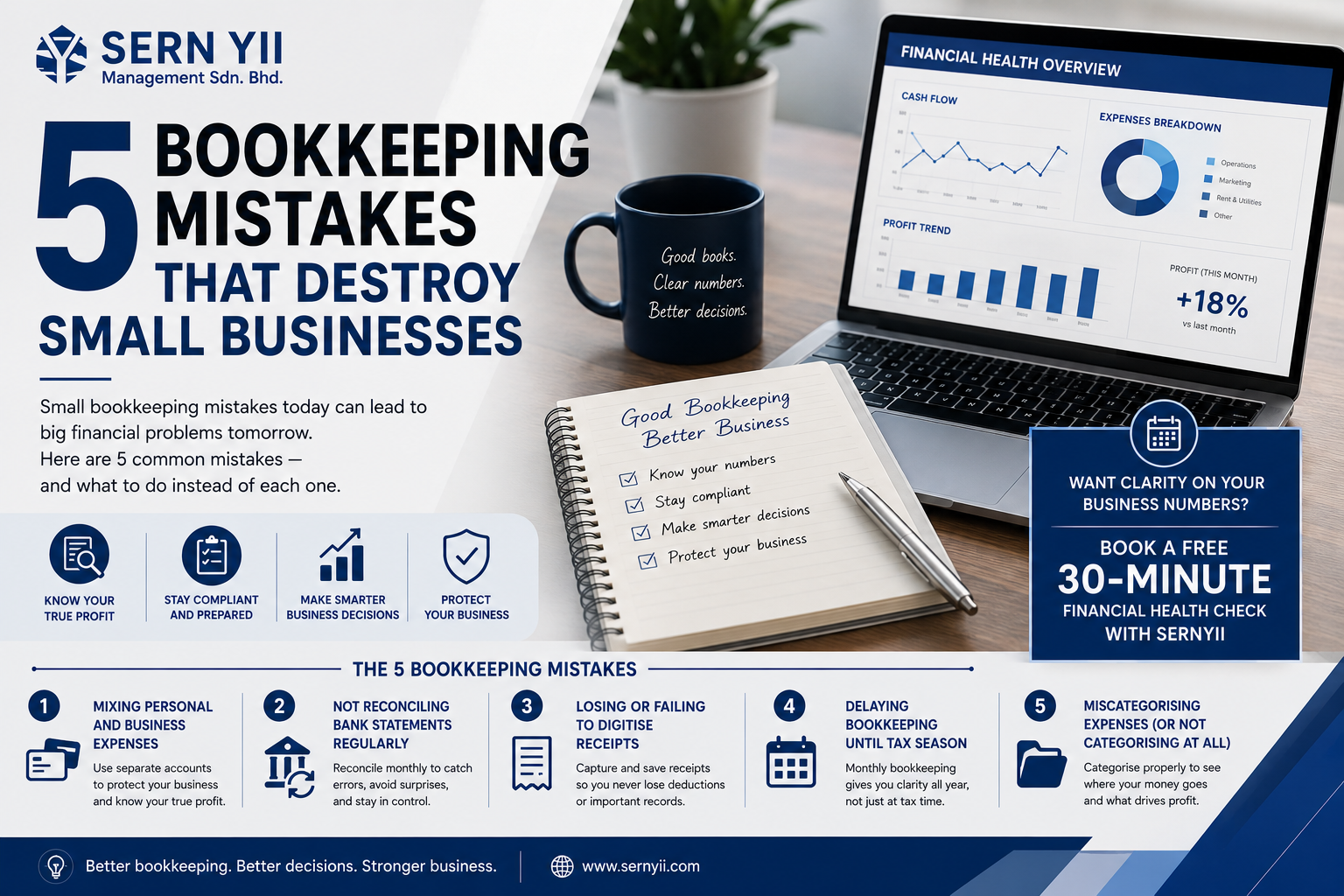
If you’re trying to pin down the bookkeeping mistakes that destroy small businesses, the uncomfortable truth is that most of them don’t look dangerous in the moment. They start small—a receipt you meant to file, a bank statement you’ll reconcile “this weekend”—and compound quietly until they surface as a missed tax deadline, a cash flow surprise, or a decision made on numbers that turned out to be wrong.
Below are five of the most common bookkeeping mistakes that destroy small businesses, why each one does more damage than it seems to, and what to do instead. Because these habits tend to feed off each other, it’s worth reading through all five rather than stopping at the first one that sounds familiar.
In This Article
- The 5 mistakes, and what to do instead
- Why these mistakes are so easy to make
- How to fix your bookkeeping starting this month
- Frequently asked questions
Quick Answer The single most damaging mistake is mixing personal and business expenses, because it makes every other bookkeeping task reconciliation, tax filing, understanding true profit—harder or impossible to do accurately.
5 Bookkeeping Mistakes That Destroy Small Businesses
Because these mistakes tend to reinforce each other, it’s worth reading through all five a business rarely makes just one of these in isolation.
1. Mixing Personal and Business Expenses
Using one bank account or one credit card for both personal and business spending is one of the most common — and most damaging — bookkeeping mistakes that destroy small businesses over time. It makes it nearly impossible to know your true profit, complicates tax filing, and in the case of a Sdn Bhd, can blur the legal separation that protects your personal assets. The fix is simple: open a dedicated business account on day one, even before the business has meaningful revenue.
2. Not Reconciling Bank Statements Regularly
Reconciliation — matching what your books say against what your bank statement actually shows — is how you catch errors, missed invoices, and even fraud early. Skip it for a few months and small discrepancies pile up into a mess that takes hours to untangle, usually right when you need clean numbers most, like before a loan application or tax filing.
3. Losing or Failing to Digitise Receipts
A shoebox of paper receipts fades, gets lost, or simply never makes it into your books. Beyond the tax deduction you lose when a receipt disappears, this habit means your expense records are incomplete—which quietly understates your true costs and overstates your profit on paper. A quick photo at the point of purchase, filed into a dedicated folder or app, closes this gap almost entirely.
4. Delaying Bookkeeping Until Tax Season
Treating bookkeeping as a once-a-year scramble instead of a monthly habit means you’re making every business decision throughout the year without knowing your actual financial position. By the time the numbers are finally compiled, the moment to act on what they show has usually already passed. Monthly bookkeeping turns your books into a decision-making tool instead of a compliance chore.
5. Miscategorizing Expenses (or Not Categorising at All)
Dumping every cost into a generic “miscellaneous” or “other expenses” category might save five minutes today, but it destroys your ability to see where money is actually going. Without proper categorization, you can’t tell whether marketing spend is paying off, whether supplier costs are creeping up, or which parts of the business are actually profitable the exact blind spot behind the margin-tracking problem covered in our piece on financial KPIs.
Why These Mistakes Are So Easy to Make
None of these five happen because an owner doesn’t care about their finances. Rather, they happen because bookkeeping competes with the more urgent, more visible parts of running a business serving customers, managing staff, and chasing the next sale. It’s easy to tell yourself you’ll sort the books out later, because nothing breaks immediately when you don’t.
The damage isn’t in any single skipped week. Instead, it’s in the compounding—three months of unreconciled statements, a year of miscategorized expenses, an entire tax season built on a shoebox of missing receipts. By the time it’s visible, it’s usually a bigger fix than it needed to be, which is exactly why catching these bookkeeping mistakes that destroy small businesses early matters so much more than fixing them later.
For a clearer sense of what proper recordkeeping is meant to look like under Malaysian law, Section 245 of the Companies Act 2016 sets out the statutory accounting records every company must keep — a useful reference once you’re ready to formalise your process.
How to Fix Your Bookkeeping Starting This Month
You don’t need to overhaul everything at once. Instead, start with whichever of these five is causing you the most pain right now, then build outward from there:
- Open a separate business bank account if you haven’t already—this alone fixes the root cause of several other mistakes
- Block 30 minutes each month to reconcile your bank statement against your books
- Photograph receipts at the point of purchase rather than saving them for later
- Set a recurring monthly bookkeeping session instead of waiting for tax season
- Review your expense categories once and set up a simple, consistent list going forward
Once these five habits are in place, the improvement tends to compound the same way the mistakes did—except in your favor. Cleaner books make tax season faster, loan applications smoother, and the KPIs covered in our related post far easier to calculate accurately.
If setting this up feels like more than you want to take on alone, Sernyii’s recordkeeping services are built specifically to help SMEs establish exactly this kind of monthly routine.
Frequently Asked Questions About Bookkeeping Mistakes
Which of these five mistakes should I fix first?
Mixing personal and business expenses, if that applies to you—it’s the one that makes every other bookkeeping task harder, so fixing it first makes the rest easier to tackle.
How much time does proper bookkeeping actually take each month?
For a small business, a consistent monthly routine—reconciliation, receipt filing, categorization—usually takes a few hours a month once the habit is established. It’s far less than the time lost untangling a year’s worth of neglected books.
At what point should I outsource bookkeeping instead of doing it myself?
Once you’re spending more time on bookkeeping than it would cost to outsource it, or once errors start affecting decisions like pricing or hiring, it’s usually worth bringing in outside help.
Can these bookkeeping mistakes actually get a small business into legal trouble?
Yes, in some cases. Incomplete records can complicate tax filings and, for a Sdn Bhd, may raise questions during an audit. Beyond the legal risk, however, the more common cost is simply making decisions—on pricing, hiring, or expansion—based on numbers that don’t reflect reality.
Not Sure Where Your Bookkeeping Stands? Book a free 30-minute financial health check with Sernyii at sernyii.com/contact-us/. We’ll take a look at your current setup and tell you honestly which of these habits, if any, need fixing first.
Sources
No responses yet