

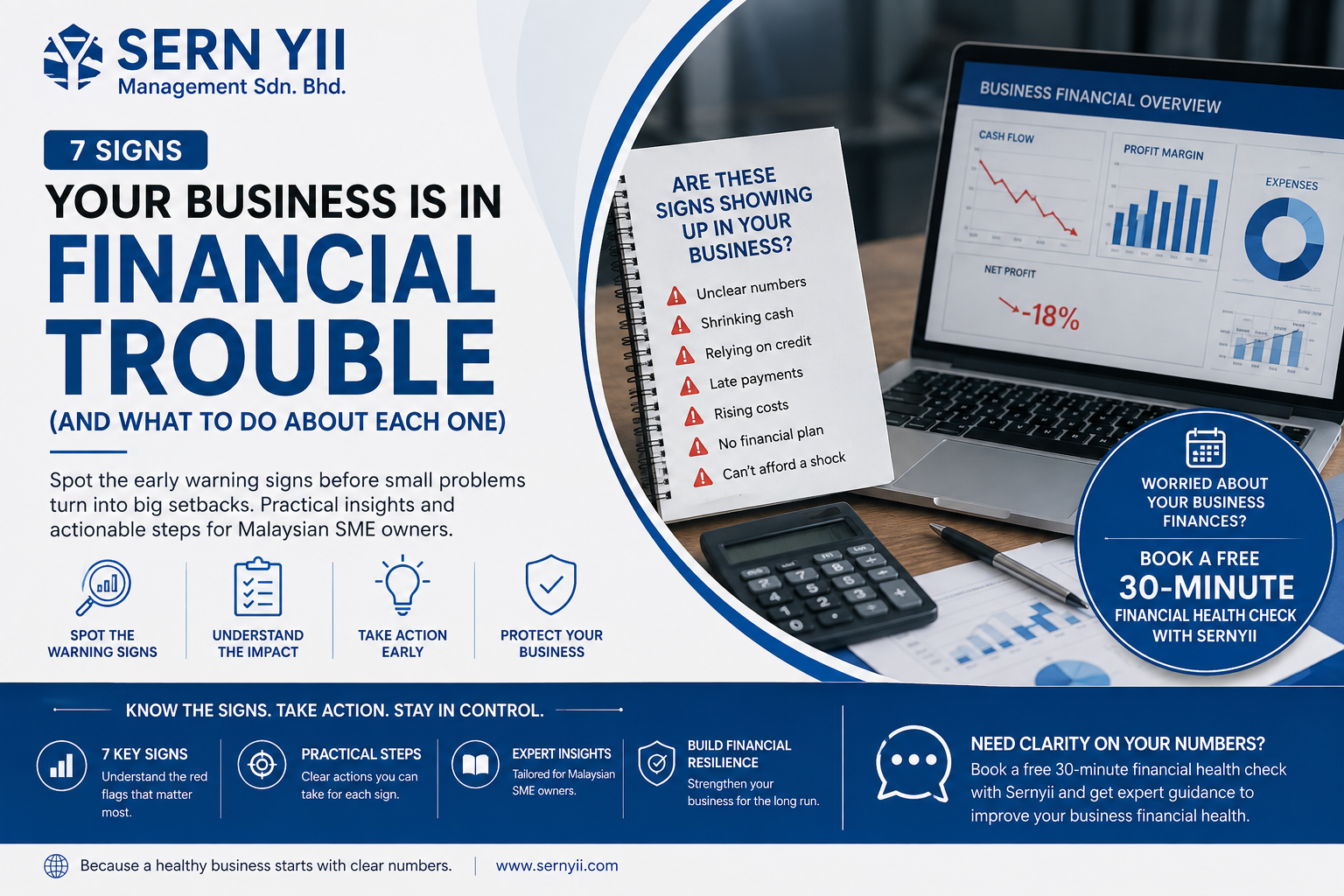
Wondering about the signs your business is in financial trouble? Here are 7 red flags Malaysian SME owners miss and what to do about each one.
If you’re searching for the signs your business is in financial trouble, chances are something already feels off even if you can’t quite name it yet. Most businesses don’t collapse overnight. Because the warning signs build slowly, they can carry on for months, sometimes years, before an owner admits something’s wrong. The problem is that these signs rarely look dramatic in the moment. They look like “a slow month,” or “just how things are right now.”
Below are seven of the clearest signs your business is in financial trouble, what each one usually means, and what to do once you’ve spotted it.
In This Article
- The 7 signs your business is in financial trouble
- Why these warning signs get missed
- What to do if you recognised one or more of these
- Frequently asked questions
Quick Answer The clearest early warning sign is a business owner who can’t answer basic questions about their own numbers without digging through statements first. Once that gap exists, the other six signs on this list tend to follow.
7 Signs Your Business Is in Financial Trouble
Because each of these signs tends to build gradually, it helps to read through all seven rather than stopping at the first one that sounds familiar most struggling businesses show two or three at once, not just one.
1. You Don’t Know Your Numbers Until Month-End (or Later). If the only time you check your financial position is when your bookkeeper sends a report weeks after the fact, you’re always making decisions on outdated information. By the time you spot a problem, it’s often already a month deep. This is one of the most common signs your business is in financial trouble, precisely because it’s invisible until something else goes wrong.
2. Revenue Is Up But Cash in the Bank Keeps Shrinking. This is one of the most common — and most confusing — financial red flags for small business owners. It usually means money is sitting in unpaid invoices, tied up in inventory, or going out faster than it’s coming in, even while sales look healthy on paper. Once revenue and cash start moving in opposite directions, it’s worth investigating immediately rather than waiting for the pattern to resolve itself.
3. You’re Relying on Credit or Loans to Cover Regular Operating Costs. Financing a new piece of equipment or a growth push is normal. However, using credit cards or loans to pay rent, salaries, or suppliers month after month is a sign the business isn’t generating enough cash on its own to sustain itself. Left unaddressed, this pattern compounds quickly through interest and fees.
4. Customer Payments Are Consistently Late. A late payment here and there is business as usual. A pattern of customers paying 30, 60, or 90 days past terms means your cash flow is effectively financing your customers’ businesses instead of your own — one of the quieter cash flow warning signs Malaysian SMEs tend to underestimate.
5. You’ve Stopped Tracking Margins Per Product or Service. Total revenue can hide a lot. Without knowing which products or services are actually profitable, it’s easy to keep pouring effort into the ones that are quietly losing you money, while the profitable ones go under-resourced.
6. Owner’s Draw Is Inconsistent with What the Business Can Actually Afford. Paying yourself based on what you need personally, rather than what the business’s cash flow supports, is one of the fastest ways to drain a company without noticing until the account runs dry.
7. You’re Avoiding Looking at Your Financial Statements. This is less a financial sign and more a behavioural one — but it’s often the most telling. If checking your numbers feels stressful enough that you keep putting it off, that avoidance is usually a signal your gut already knows something the spreadsheet would confirm.
Why These Warning Signs Get Missed
Most of these red flags don’t show up as a single alarming number. Instead, they build slowly, hidden inside day-to-day busyness — fulfilling orders, managing staff, chasing the next sale. By the time the pattern becomes obvious, the business often has fewer options left to fix it.
The good news: every sign on this list is reversible once it’s caught. None of them require a dramatic turnaround. Most need a consistent habit of looking at the numbers, and a clear read on what those numbers are actually saying — which is exactly where a monthly bookkeeping routine or an outside set of eyes makes the biggest difference.
What to Do If You Recognised One or More of These Signs
Once you’ve identified which signs apply to your business, the next step is turning that awareness into a routine. Here’s where to start:
- Start with a monthly cash flow review, separate from your profit and loss statement — they tell you different things
- Age your accounts receivable and follow up on anything over 30 days
- Break down revenue and costs by product or service line, even roughly, to see where margin actually sits
- Set owner’s draw based on a percentage of profit, not a fixed personal budget
- Book a review with an accountant before the numbers force the conversation
For a wider view of Malaysia’s SME financing and advisory support options, SME Corp Malaysia’s resource hub is a useful external reference point when your business needs external funding to stabilise cash flow.
Frequently Asked Questions About Financial Trouble Signs
Is one red flag enough to worry about, or does it need to be several?
One sign on its own is usually manageable and worth fixing quickly. It’s when two or three show up together — especially late payments plus reliance on credit — that the situation tends to escalate faster than owners expect.
How often should I be checking these numbers?
Monthly, at minimum. Businesses with tighter cash flow or seasonal swings often benefit from a weekly cash position check, even if the full financial review stays monthly.
Can a business recover from all seven signs at once?
Yes, but it takes longer and usually requires outside help to prioritise what to fix first. The earlier these signs your business is in financial trouble are caught, the fewer trade-offs there are to make.
Not Sure Where Your Business Stands? Book a free 30-minute financial health check with Sernyii. We’ll go through your numbers together and give you an honest read on where things stand — no jargon, no judgment.
sources
https://sernyii.com/how-financial-reports-drive-better-business-strategy-a-breakdown-for-sme-owners/
No responses yet