

Updated for Year of Assessment 2026
If you run a Sdn Bhd in Malaysia, one number matters more than almost anything else on your income statement: your effective corporate tax rate. Get it wrong and you either overpay LHDN or underpay and risk penalties. Get it right and you free up real cash for hiring, stock, or growth.
This guide breaks down the Malaysian corporate tax rates for 2026, exactly who qualifies as an SME for preferential rates, a worked calculation you can copy for your own numbers, the deductions most businesses miss, and the filing deadlines you need on your calendar.
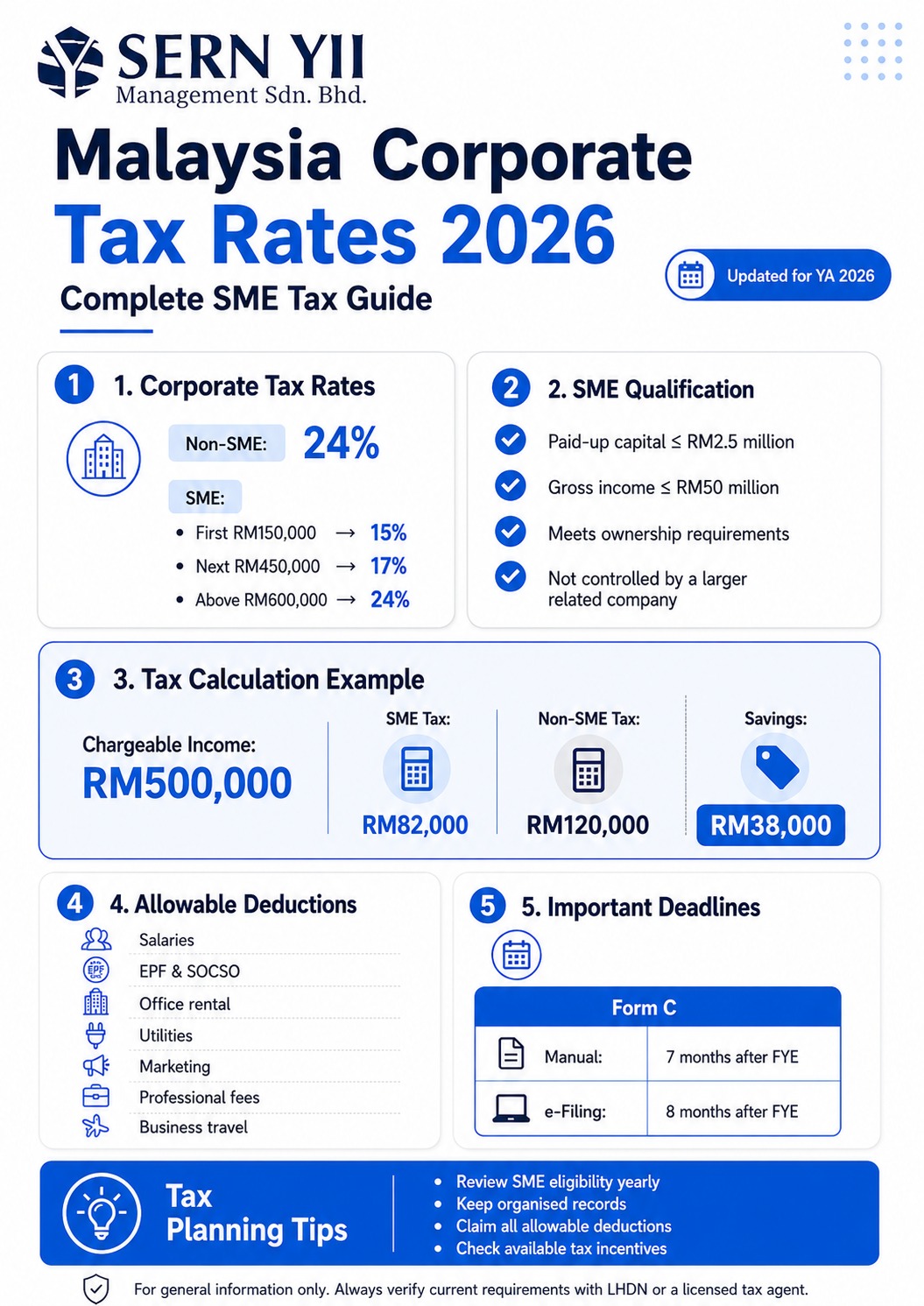
Quick answer: Non-SME companies pay a flat 24% on all chargeable income. Qualifying SMEs pay 15% on the first RM150,000, 17% on the next RM450,000, and 24% above RM600,000.
Table of Contents
What Is Corporate Income Tax?
Malaysia Corporate Tax Rates 2026
Who Qualifies for SME Tax Rates?
Corporate Tax Rates at a Glance
How to Calculate Corporate Tax
Worked Example
Allowable Business Expenses
Corporate Tax Incentives
Filing Deadlines for YA 2026
Common Tax Mistakes
Tax Planning Tips
FAQ
What Is Corporate Income Tax?
Corporate income tax is what a company pays LHDN (Lembaga Hasil Dalam Negeri, Malaysia’s Inland Revenue Board) on its chargeable income for a given Year of Assessment (YA). Chargeable income isn’t the same as revenue — it’s what’s left after allowable deductions and capital allowances are applied.
The amount a company owes depends on:
Company size and structure
Chargeable income
Whether it qualifies as an SME
Allowable deductions claimed
Capital allowances
Any tax incentives it’s eligible for
Malaysia runs a tiered system for qualifying SMEs and a flat rate for everyone else. Knowing which category you fall into and confirming it every year is the single biggest lever most small businesses have over their tax bill.
Malaysia Corporate Tax Rates 2026
Standard Corporate Tax Rate
Resident companies that don’t qualify as SMEs pay:
24% on all chargeable income, regardless of how much they earn.
SME Preferential Tax Rates
Qualifying SMEs get a tiered structure on their first RM600,000 of chargeable income:
| Chargeable Income | Tax Rate |
| First RM150,000 | 15% |
| RM150,001 – RM600,000 | 17% |
| Above RM600,000 | 24% |
This tiered structure is designed to lighten the load on smaller businesses in their growth phase, while larger, more established SMEs still pay the standard rate on income above the RM600,000 threshold.
Who Qualifies for SME Tax Rates?
To claim SME tax rates, a company generally must meet all of the following conditions:
✅ Paid-up capital of RM2.5 million or less
✅ Gross business income not exceeding RM50 million
✅ Not controlled by a related company with paid-up capital above RM2.5 million
✅ Foreign ownership within the applicable threshold
Miss even one condition, and your company defaults to the standard 24% rate; no partial qualification exists. This is the single most common reason businesses overpay: they assume Sdn Bhd status alone makes them an SME, when in practice all four boxes need to be ticked.
Tip: If your paid-up capital is close to RM2.5 million or you’re planning a funding round, check your SME eligibility before the round closes; crossing the threshold mid-year can affect your rate for the following YA.
Corporate Tax Rates at a Glance
| Company Type | Chargeable Income | Tax Rate |
| Non-SME | All income | 24% |
| SME | First RM150,000 | 15% |
| SME | RM150,001 – RM600,000 | 17% |
| SME | Above RM600,000 | 24% |
How to Calculate Corporate Tax
Determine your company’s annual revenue.
Deduct allowable business expenses.
Apply capital allowances where applicable.
Arrive at your chargeable income.
Confirm whether your company qualifies for SME tax rates.
Apply the relevant tax brackets to that chargeable income.
Factor in any tax incentives your business qualifies for.
Worked Example
Assume a qualifying SME has RM500,000 in chargeable income for YA 2026.
Qualifying SME
| Bracket | Calculation | Tax |
| First RM150,000 | RM150,000 × 15% | RM22,500 |
| Remaining RM350,000 | RM350,000 × 17% | RM59,500 |
| Total corporate tax | RM82,000 |
Non-SME (same income)
RM500,000 × 24% = RM120,000
Tax savings from SME status: RM38,000
That’s the practical impact of confirming your SME status correctly — on RM500,000 of chargeable income, it’s the difference between a 24% effective rate and roughly a 16.4% effective rate.
Allowable Business Expenses
Businesses can generally deduct legitimate operating expenses incurred wholly and exclusively in producing business income, including:
Employee salaries and EPF/SOCSO contributions
Office rental
Utilities
Professional fees (accounting, legal, secretarial)
Office supplies
Business insurance
Marketing and advertising
Business travel
Personal expenses and non-business costs generally aren’t deductible. Keeping complete, well-organised records throughout the year not just at filing time is what actually protects these deductions if LHDN ever asks for supporting documents.
Corporate Tax Incentives
Certain industries and activities may qualify for incentives that reduce a company’s effective tax rate, including those related to:
Digital economy activities
Green technology
Tourism
Agriculture
Malaysia Digital status
Pioneer Status
Investment Tax Allowance
Eligibility criteria and available programmes change periodically, so it’s worth reviewing your incentive eligibility every year rather than assuming last year’s status still applies.
Filing Deadlines for YA 2026
Corporate tax return (Form C) deadlines are tied to your company’s financial year-end (FYE), not the calendar year:
Manual filing: within 7 months of your FYE
e-Filing: within 8 months of your FYE
For example, a company with an FYE of 31 December 2025 would file Form C by around 31 July 2026 (manual) or 31 August 2026 (e-Filing).
Companies must also submit CP204, the annual tax estimate under Section 107C of the Income Tax Act 1967, and keep supporting records for at least seven years under Malaysia’s Self-Assessment System.
Deadlines and thresholds can be revised by LHDN. Always confirm current dates on the official LHDN / MyTax portal or with a licensed tax agent before filing.
Common Tax Mistakes
Assuming the company automatically qualifies for SME tax rates
Claiming non-deductible personal expenses
Poor or incomplete record keeping
Missing available tax incentives
Not reviewing SME eligibility annually
Underestimating CP204 installments and triggering surcharges
Tax Planning Tips
Review tax incentive eligibility every year
Keep organised, audit-ready financial records
Monitor SME eligibility, especially around funding rounds or ownership changes
Track deductible business expenses in real time, not at year-end
Consult a licensed tax agent when circumstances change (new investors, new revenue lines, restructuring)
Why Corporate Tax Planning Matters
Corporate tax touches far more than annual compliance; it shapes
Cash flow management
Investment decisions
Capital expenditure timing
Business expansion plans
Dividend planning
Long-term financial strategy
Businesses that treat tax planning as an ongoing process rather than a once-a-year scramble before the Form C deadline consistently end up with better outcomes and fewer surprises.
Frequently Asked Questions
What is Malaysia’s corporate tax rate for 2026? The standard rate for resident companies is 24%. Qualifying SMEs pay 15% on the first RM150,000, 17% on the next RM450,000, and 24% above RM600,000.
Who qualifies as an SME for tax purposes? A company generally needs paid-up capital of RM2.5 million or less, gross income under RM50 million, no control by a related company exceeding the capital threshold, and compliant foreign ownership.
How is corporate tax calculated in Malaysia? Tax is calculated on chargeable income — revenue minus allowable expenses and capital allowances — using either the SME tiered rates or the flat 24% rate, depending on eligibility.
When is Form C due for YA 2026? Within 7 months of your financial year-end for manual filing or 8 months for e-filing.
Can an Sdn Bhd automatically claim SME rates? No. Incorporation as an Sdn Bhd doesn’t automatically qualify a company; all SME eligibility conditions must be met independently.
What happens if my company doesn’t qualify as an SME? You’re taxed at the flat 24% rate on all chargeable income, with no access to the lower-tiered brackets.
Can businesses claim tax incentives on top of SME rates? Yes, in some cases incentives like Pioneer Status or Investment Tax Allowance are separate from SME tax brackets and may apply if your business meets sector-specific criteria.
What counts as chargeable income? Chargeable income is your revenue after deducting allowable business expenses and capital allowances, not your gross revenue.
Why should I review my SME eligibility every year? Paid-up capital, ownership, and income levels can change year to year, and any one shift can move you out of SME status and into the standard 24% rate.
Do I need a tax agent to file Form C? It’s not legally required, but a licensed tax agent reduces audit risk and can identify deductions or incentives many businesses miss.
HDN guidance or a licensed tax agent before filing.
No responses yet