

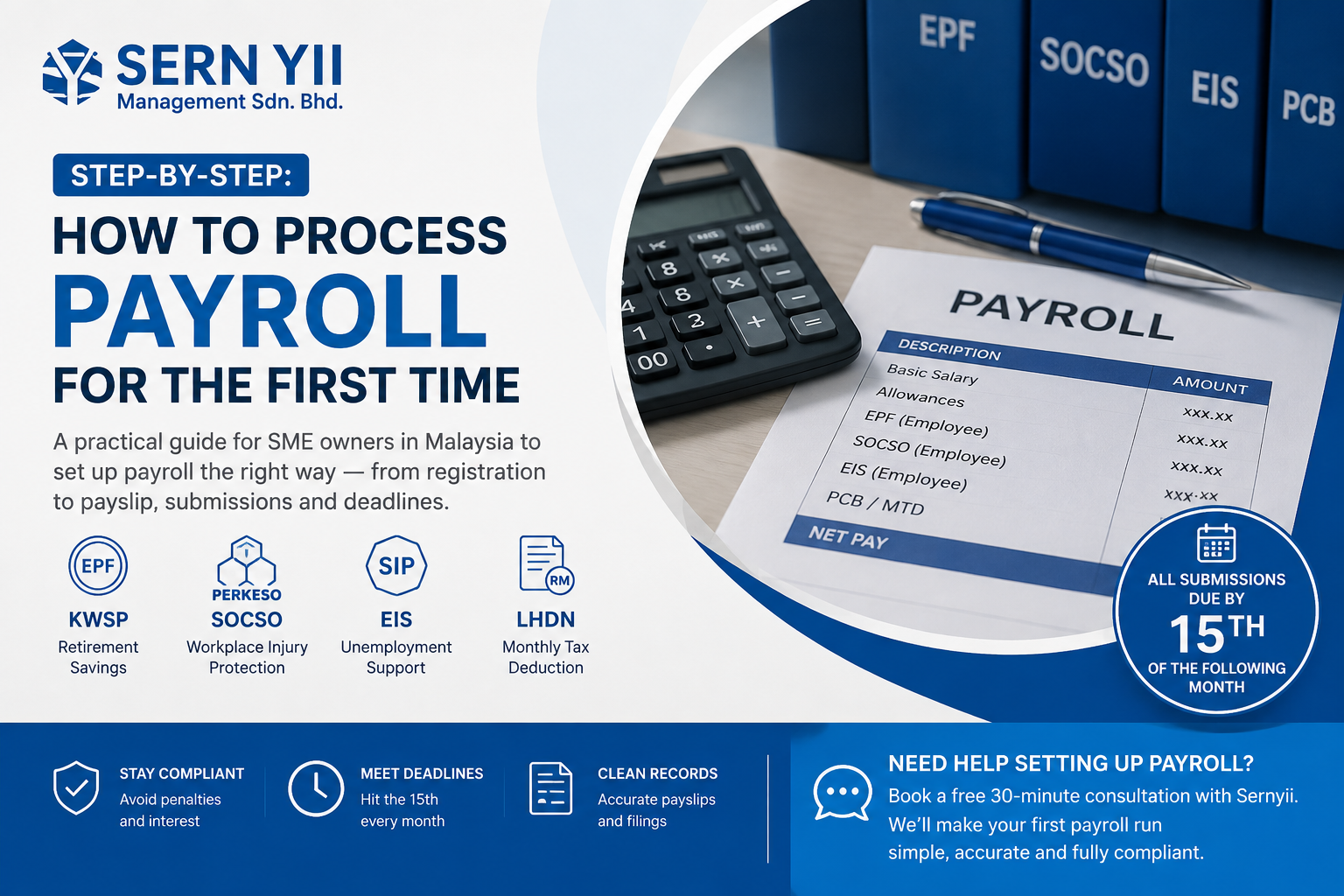
Step-by-Step: How to Process Payroll for the First Time
Hiring your first employee is a big milestone — and it comes with a new set of legal obligations most SME owners haven’t dealt with before. Malaysian payroll isn’t just “pay the salary.” It involves registering with three separate statutory bodies, calculating four different deductions correctly, and hitting monthly deadlines that carry real penalties if missed.
This guide walks you through the process in order, from registration to your first payslip.
| Quick Answer Before your first payday: register as an employer with LHDN, EPF and SOCSO/EIS, register the employee within their required windows, then calculate EPF, SOCSO, EIS and PCB on gross wages. All four statutory contributions are due by the 15th of the following month. Miss that, and interest and penalties apply from day one. |
Before You Start: What Payroll in Malaysia Actually Covers
Every payslip in Malaysia involves four separate statutory calculations, each with its own authority, rate table and submission portal:
- EPF (KWSP) — retirement savings
- SOCSO (PERKESO) — workplace injury and invalidity protection
- EIS (SIP) — unemployment support, administered by PERKESO alongside SOCSO
- PCB/MTD (LHDN) — monthly income tax withholding
Get any of these wrong and you’re not just short-changing your employee — you’re exposing the company (and its directors) to fines, interest, and in serious cases prosecution.
Step 1: Register as an Employer with LHDN
- Apply for an employer’s tax reference number (E number) with LHDN before your first hire — you need this to remit PCB.
- Register via LHDN’s MyTax portal if you don’t already have one from a previous business.
- Keep this number on hand; you’ll need it for every monthly PCB submission going forward.
Step 2: Register with EPF (KWSP)
- Register your company as an employer with KWSP — this is separate from LHDN registration.
- Register each new employee under your EPF employer account within the required window from their start date.
- Obtain your EPF employer reference number, used for all future monthly contributions.
Step 3: Register with SOCSO and EIS (PERKESO)
- Register your business and each new employee with PERKESO, which handles both SOCSO and EIS under one registration.
- New employees must be registered within 30 days of their start date.
- Set up access to the ASSIST Portal, which you’ll use every month to submit SOCSO and EIS contributions.
Step 4: Understand the Contribution Rates
Once registration is done, you need to know what to deduct and what to contribute as the employer. Here’s the current breakdown for a Malaysian employee under 60:
| Contribution | Employee Share | Employer Share |
| EPF (KWSP) | 11% of monthly wages | 13% if wages ≤ RM5,000/month, 12% if above (Third Schedule table applies for wages up to RM20,000) |
| SOCSO | Per PERKESO wage table (roughly 0.5% of insured wages) | Per PERKESO wage table (roughly 1.75% of insured wages) |
| EIS | 0.2% of monthly wages | 0.2% of monthly wages |
| PCB/MTD | Calculated per LHDN’s PCB schedule or Computerised Calculation Method, based on reliefs claimed | N/A — employer withholds and remits on employee’s behalf |
SOCSO and EIS apply on wages up to a ceiling of RM6,000 a month. EPF has no contribution cap — it applies to the full monthly wage. If you employ foreign workers, note that EPF became mandatory for them from October 2025, at 2% employee and 2% employer.
Step 5: Calculate PCB (Monthly Tax Deduction)
- Confirm the employee’s tax reliefs — married status, number of children, EPF contributions, insurance, and any TP1 declaration they submit.
- Use LHDN’s PCB Schedule (Jadual PCB) for manual calculation, or the Computerised Calculation Method if you’re using payroll software — most SMEs use the latter for accuracy.
- Submit and pay via e-Data PCB, e-PCB, or e-CP39 on LHDN’s MyTax portal.
PCB depends heavily on each employee’s personal circumstances, so it’s rarely a flat percentage — get this wrong and the employee’s year-end tax position will be off, which becomes your problem to explain.
Step 6: Run the First Payroll Calculation
With registrations done and rates confirmed, calculating gross-to-net pay for your first employee follows this order:
- Start with gross monthly wages (basic salary + fixed allowances).
- Deduct the employee’s EPF share (11%).
- Deduct the employee’s SOCSO share (per wage table).
- Deduct the employee’s EIS share (0.2%).
- Deduct PCB based on the employee’s tax profile.
- What’s left is net pay — the amount that goes into their bank account.
Separately, calculate your employer contributions (EPF 12–13%, SOCSO ~1.75%, EIS 0.2%) — these come out of company funds, not the employee’s salary, and are on top of what you pay them.
Step 7: Issue a Compliant Payslip
Under Malaysian employment law, every payslip must show gross wages, all itemised deductions (EPF, SOCSO, EIS, PCB), and net pay, along with the pay period covered. Keep digital or physical records — you’ll need them for audits and annual filings.
Step 8: Submit and Pay by the 15th
All four contributions — EPF, SOCSO, EIS, and PCB — are due by the 15th of the month following the salary payment. This is the single most important date to build your payroll calendar around.
- EPF: submit via i-Akaun (Employer)
- SOCSO/EIS: submit via the ASSIST Portal
- PCB: submit via e-Data PCB, e-PCB, or e-CP39 on MyTax
Miss the deadline and SOCSO/EIS late payments attract 6% per annum interest calculated daily, with a minimum charge of RM5 a month — and further penalties can apply under the Employees’ Social Security Act 1969 for repeated non-compliance. EPF and LHDN apply their own separate late-payment penalties.
Step 9: Don’t Forget Form E — Once a Year
Beyond the monthly cycle, every employer must submit Form E to LHDN annually by 31 March of the following year, declaring all employee remuneration — even if you had no employees that year. This is separate from your monthly PCB submissions and easy to forget in your first year.
Common First-Time Payroll Mistakes
- Registering the employee late — EPF and SOCSO both have registration windows tied to the employee’s start date, not your payroll run date
- Using a flat percentage for EPF instead of the Third Schedule table, which applies different rounding rules for wages up to RM20,000
- Forgetting that SOCSO/EIS apply per the official wage table, not a straight percentage calculation
- Missing the 15th-of-the-month deadline in the very first cycle, before a routine is established
- Not keeping payslip records that show the itemised breakdown required by law
Should You Handle Payroll In-House or Outsource It?
For a first hire or two, many SME owners manage payroll manually using LHDN’s schedules and government portals. Once you’re managing multiple employees, varying pay structures, or don’t have time to track rate changes and deadlines every month, outsourcing to a payroll provider or accountant removes the compliance risk — and the 6am panic on the 15th.
Frequently Asked Questions
Do I need to register with EPF and SOCSO even for one employee?
Yes. There’s no employee-count threshold for EPF and SOCSO/EIS registration — hiring even one eligible employee triggers the requirement.
What if my employee is a foreign worker?
Foreign workers have been subject to mandatory EPF contributions since October 2025, at 2% employee and 2% employer. SOCSO and EIS registration requirements apply to foreign workers as well, subject to their specific visa category.
Is HRD Corp levy also mandatory?
Only if your company has 10 or more Malaysian employees — smaller SMEs are generally exempt but can register voluntarily to access training subsidies.
What happens if I miss the 15th-of-the-month deadline?
Interest and penalties apply, and they start from the missed deadline itself, not from a grace period. For SOCSO/EIS this is 6% per annum calculated daily with a minimum RM5/month charge; EPF and LHDN apply their own penalty structures.
| Setting Up Payroll for the First Time? Book a free 30-minute consultation with Sernyii. We’ll walk through your registrations, set up your contribution calculations correctly from day one, and make sure your first payroll run is fully compliant. |
Disclaimer: This article is for general informational purposes and does not constitute tax or legal advice. Contribution rates, wage ceilings and deadlines are reviewed periodically — verify current figures with KWSP (kwsp.gov.my), PERKESO (perkeso.gov.my) and LHDN (hasil.gov.my), or speak with a Sernyii advisor before setting up payroll.
No responses yet