

Your business owns equipment, has money in the bank, and receives customer orders. But how much does it owe, and how strong is its financial position?
Knowing how to read a balance sheet helps you ask better questions before hiring, borrowing, or expanding. For Malaysian SME owners, it is a useful starting point for understanding what sits behind the business’s financial numbers.
You do not need to become an accountant. Start with three sections and a few practical checks.
What is a balance sheet?
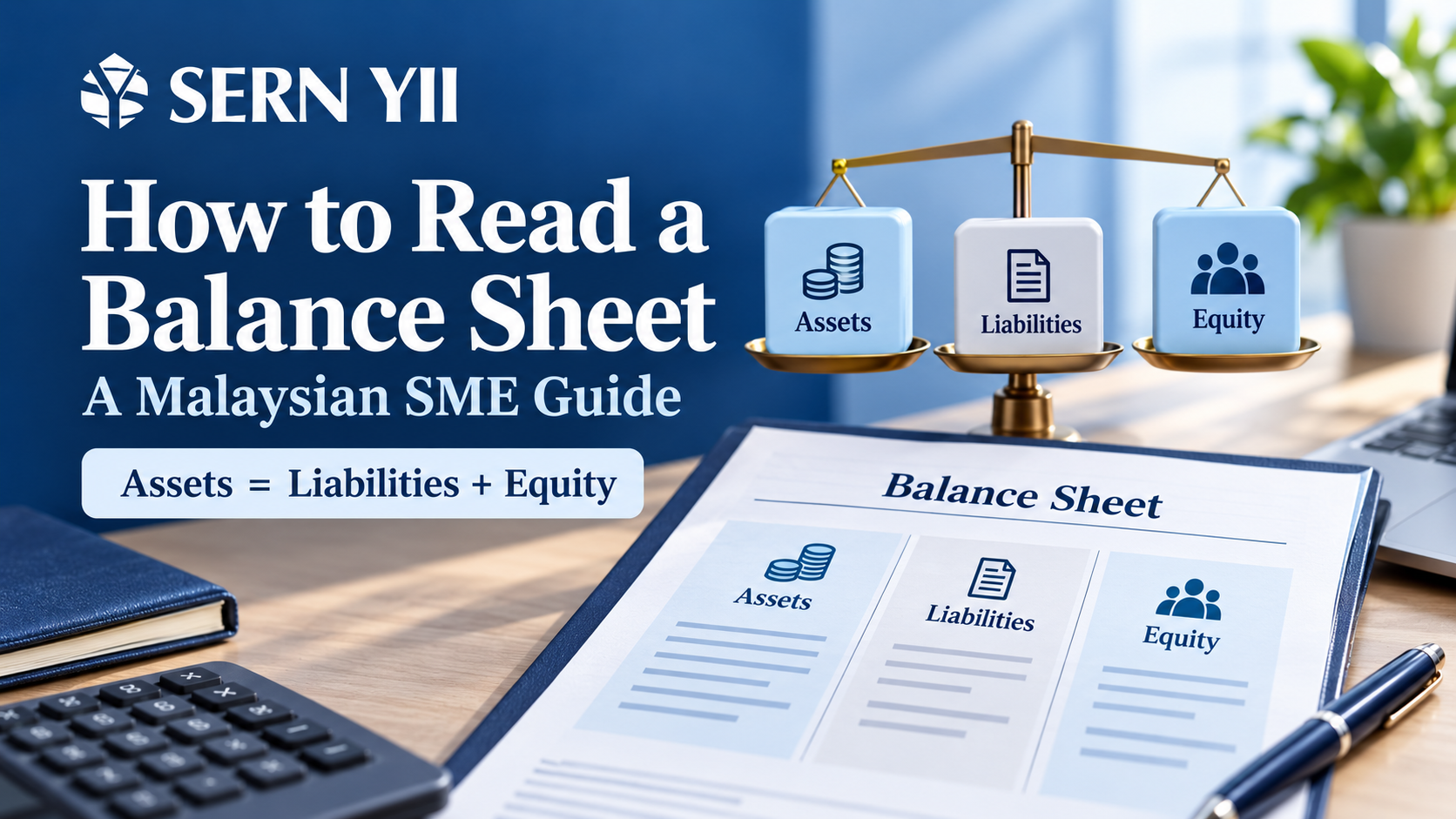
A balance sheet, also called a statement of financial position, shows a business’s assets, liabilities, and equity at a specific date. Unlike a report covering sales over several months, it captures the financial position at that reporting date.
Its basic equation is
Assets = Liabilities + Equity
In plain language, the resources recorded by the business are financed through obligations to others and the owners’ interest.
1. Understand what the business owns or controls
Assets include resources such as cash, customer receivables, inventory, and equipment.
When reviewing this section, look beyond the total. Ask:
- How much cash is available?
- How much money is still owed by customers?
- How much stock remains unsold?
- How much is invested in equipment and other long-term assets?
A large asset balance does not necessarily mean the business has plenty of money available to spend.
Equipment supports operations, but it cannot usually pay next week’s salaries without first being sold or used to obtain financing.
2. Check what the business owes.
Liabilities include obligations such as supplier balances, loans, and accrued expenses.
Review the supporting schedules to understand when payments fall due. A single total cannot tell you whether several large payments are concentrated in the same week.
Prepare a payment calendar alongside the balance sheet. Include upcoming supplier payments, loan installments, and other commitments so your team can plan cash requirements.
3. Understand the equity section
Equity is the residual interest after deducting liabilities from assets. Depending on the business structure, it can include contributed capital, retained earnings, and reserves.
Retained earnings should not be mistaken for cash available in the bank. Profits retained in the business may have been used to purchase assets, fund inventory, or support customer credit.
Likewise, the equity figure is not automatically the price someone would pay to buy the business.
4. Look at short-term financial pressure.
One useful measure is the current ratio:
Current ratio = Current assets ÷ Current liabilities
This compares current assets with current liabilities. However, a higher figure does not automatically mean the business can comfortably meet every payment.
Inventory may take time to sell, and customer balances may take time to collect. Review liquidity ratios alongside operating cash flow and the circumstances of your industry.
The practical question is, will cash become available before the bills need to be paid?
5. Compare balances over time.
Read the latest balance sheet alongside earlier periods. Investigate changes rather than assuming that every increase is good or every decrease is bad.
Useful questions include:
- Why have customer balances increased?
- Is stock building up faster than it is selling?
- What caused the change in borrowing?
- Does the movement in cash match management’s expectations?
For seasonal businesses, comparing the same month in the previous year may provide more context than comparing consecutive months alone.
Turn your review into action.
After reviewing the figures, create a short action list. Assign someone to investigate overdue customer balances, review slow-moving stock, or explain unusual account movements.
Record a follow-up date. A financial report becomes more useful when its findings lead to clear decisions.
For a closer look at customer and supplier balances, read our guide to accounts receivable and accounts payable.
Frequently asked questions
Does a balanced balance sheet mean the accounts are accurate?
No. The equation can balance even when transactions are missing, duplicated, or incorrectly classified. Supporting records and reconciliations still matter.
Can a balance sheet tell me everything about business performance?
No. Read it alongside the profit and loss statement, cash flow information, and relevant notes. Each provides a different part of the picture.
How often should an SME owner review it?
A monthly review is a practical management habit, provided the bookkeeping is sufficiently up to date. Choose a schedule that supports your business decisions.
Understand your numbers with Sern Yii.
Your financial reports should help you make decisions more clearly.
Need help understanding your accounts? Contact Sern Yii to discuss bookkeeping and accounting support for your business.
Sources
IFRS Foundation — Statement of Financial Position
Explains the balance sheet and its three main elements: assets, liabilities, and equity.
IFRS Foundation — Conceptual Framework for Financial Reporting
Supports the explanation of assets, liabilities, and equity.
ACCA — Ratio Analysis
Explains liquidity ratios and why they should be assessed alongside operating cash flow.
No responses yet