

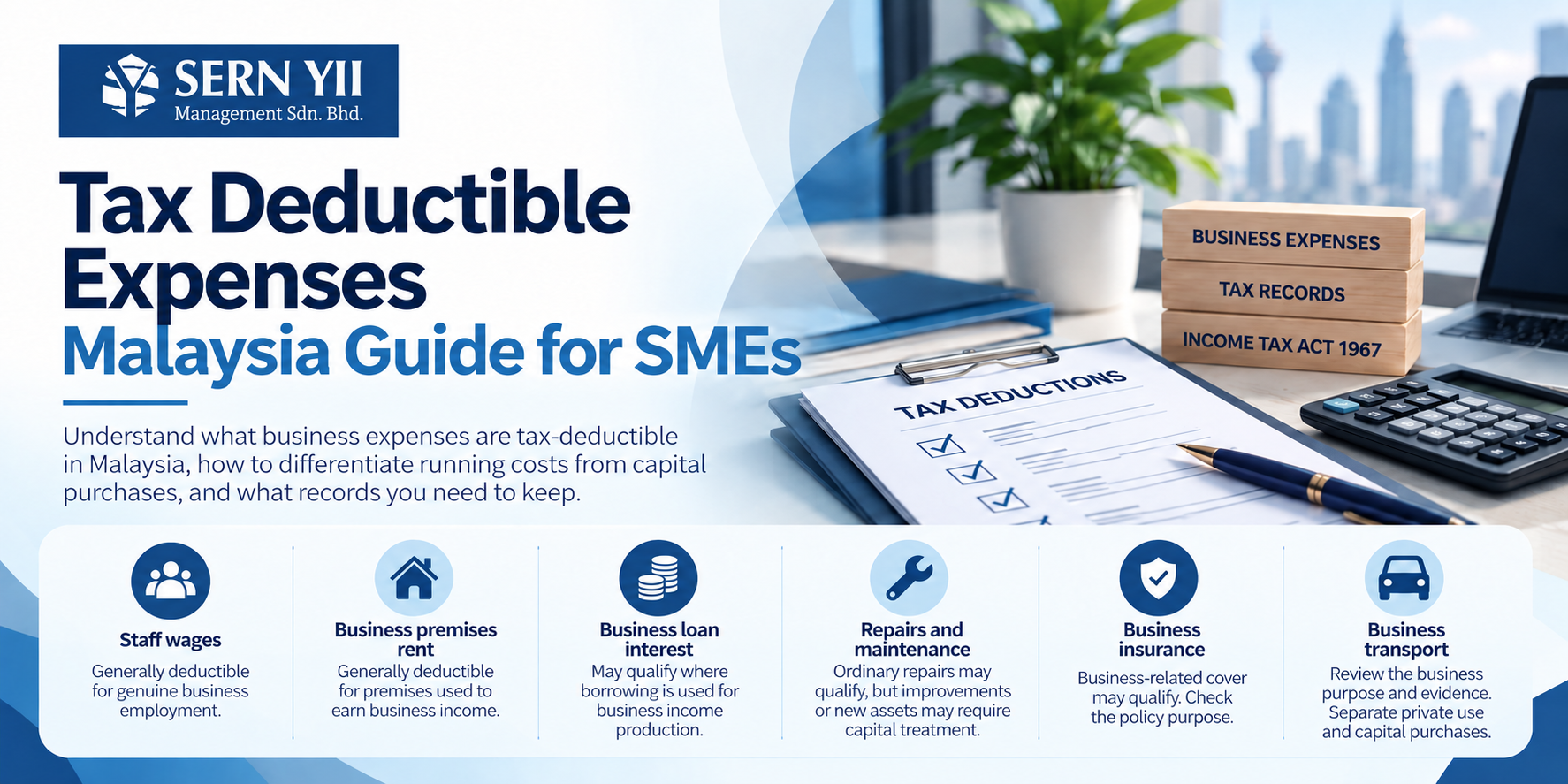
Understanding tax-deductible expenses in Malaysia starts with one question: what was the expense for? A payment from the company bank account is not automatically an allowable tax deduction. The business purpose, type of expense, and supporting records all matter.
For SME owners, the practical goal is to identify legitimate claims without treating every purchase as a way to reduce tax. This guide explains common categories, the difference between running costs and assets, and how to prepare records for review.
Quick answer
The general rule under section 33(1) of the Income Tax Act 1967 is that an expense must be incurred wholly and exclusively in producing gross income from the relevant source. Specific restrictions and special deduction rules still apply. Ordinary business wages and premises rent may qualify; private spending, capital purchases, and accounting depreciation do not qualify as ordinary revenue deductions.
Scope: this article concerns ordinary Malaysian business income tax deductions, particularly for SMEs and Sdn Bhd companies. It does not cover personal tax reliefs, special industry incentives, or the separate Labuan business tax regime.
Common business expenses to review
These are starting categories for review, not automatic approvals. Match each claim to the business activity and the relevant accounting period.
| Expense | Typical treatment and checks |
| Staff wages | Generally deductible for genuine business employment. Keep payroll records and supporting employment documents. |
| Business premises rent | Generally deductible for premises used to earn business income. Keep the tenancy agreement and payment records. |
| Business loan interest | May qualify where borrowing is used for business income production. Restrictions can apply; loan principal is not interest. |
| Repairs and maintenance | Ordinary repairs may qualify as separate restoration from improvements or new assets requiring capital treatment. |
| Business insurance | Business-related cover, such as fire or burglary insurance, may qualify. Check the policy purpose. |
| Business transport | Review the actual business purpose and evidence. Separate private journeys and capital vehicle purchases. |
Use a simple review test.
For each transaction, record who supplied it, what was bought, which activity needed it, and where the evidence is saved. Then flag anything with private use, asset characteristics, or unusual payment terms for the accountant. This makes the tax review more useful than a folder of unexplained receipts.
For example, a payment description saying “transfer” tells your accountant very little. “Office rent for September, under tenancy dated 1 January” explains both the purpose and the period.
Restricted expenses and capital purchases
Private spending and mixed use
Keep personal spending out of business deductions. For a cost with both business and private use, identify and support the business portion before claiming it. A company card does not turn a personal purchase into an income-producing expense.
As a practical control, ask staff to record the business purpose when submitting a claim. Where a transaction is partly personal, show the split explicitly instead of leaving the accountant to guess at year-end.
Equipment and depreciation
Buying equipment is different from paying a running cost. A qualifying business asset may receive capital allowances under Schedule 3, rather than an immediate ordinary expense deduction. Accounting depreciation is not the tax deduction. Eligibility, asset classification and the applicable allowance must be assessed separately.
Keep an asset register showing the purchase date, cost, description, and use. This helps separate equipment from consumables and prevents the same purchase being claimed twice.
Entertainment and specialist fees
Entertainment has its own rules. HASiL’s Public Ruling 4/2015 distinguishes qualifying 100% and 50% deductions; do not assume every meal or gift is fully deductible. Record the purpose and who attended or received it.
Tax filing and company secretarial fees also have specific deduction rules. Check the applicable conditions and limits instead of grouping every professional fee into one unrestricted claim.
Worked example of an expense review
Assume an SME records these purchases for review. The example illustrates classification only; it is not a complete company tax computation.
| Item | Amount | Treatment assumed for this example |
| Office rent | RM3,000 | Business use established; RM3,000 revenue deduction. |
| Staff wages | RM8,000 | Genuine business employment; RM8,000 revenue deduction. |
| Personal groceries | RM300 | Private spending; no business deduction. |
| New office laptop | RM4,000 | Capital asset; review capital allowances separately. |
Total spending is RM15,300. On these assumptions, the ordinary revenue deductions shown are RM11,000. The RM4,000 laptop is reviewed separately for capital allowances; the RM300 private purchase is excluded.
This does not mean the company saves RM11,000 in tax. A deduction reduces the income used in tax computation. The actual tax effect depends on the company’s taxable position, applicable rates, and other adjustments.
Records that support your tax deductions
Keep invoices and receipts alongside bank evidence, contracts, payroll records, and the ledger entries they support. HASiL’s company record-keeping ruling explains that the records should allow the business income or loss to be ascertained.
Business records generally need to be retained for seven years from the end of the year to which the income relates. Late-filed returns can change the retention period. Check the applicable period before destroying records; do not count seven years from the purchase date alone.
A practical monthly expense checklist
- Match each payment to its invoice, receipt, or other supporting document.
- Record the business purpose while the people involved can still explain it.
- Separate personal transactions and flag mixed-use costs.
- Move asset purchases to the asset register for review.
- Flag entertainment and other expenses that are subject to special rules.
- Give the accountant a list of missing documents and unresolved items.
Keep records in a consistent folder structure, with a link or reference from the ledger to the document. A searchable file named with the supplier, date, and invoice number is easier to review than an unidentified photograph.
Frequently asked questions
Does a receipt guarantee a tax deduction?
No. A receipt supports what was purchased, but the business purpose and tax treatment still need to be qualified. Keep an explanation of the transaction where that purpose is not obvious.
Can I claim the full cost of a laptop immediately?
Do not automatically treat it as an ordinary running expense. Review the applicable capital allowance treatment and any qualifying accelerated or small-value asset rules with your adviser.
Can personal tax reliefs be claimed by an Sdn Bhd?
Personal reliefs belong in the relevant individual tax computation. They are not a substitute for assessing whether a company expense qualifies as a business deduction. Keep the company’s records and the owner’s personal tax records separate.
What if I cannot find an invoice?
Ask the supplier for a replacement and preserve other evidence, such as the order, delivery record, and bank payment. Explain the gap to your accountant. A payment record alone may not establish what was bought or its business purpose.
How Sern Yii can help
Unsure which expenses belong to your company’s tax computation? Sern Yii can help organize your bookkeeping and review the records supporting your tax preparation. Visit https://sernyii.com/ to discuss your business expenses and accounting needs.
This guide provides general information. Have an appropriately qualified tax professional assess the facts and current rules for your company before filing.
Sources and publishing checks
The source numbers below correspond to the references in the articles. Links were researched.
JTKSM Employment Regulations 1957 Regulations 5(b) and 8.
HASiL new employee notification—e-CP22 scope and 30-day deadline.
HASiL guidelines directory Secretarial and tax filing fee guidance dated 10 November 2023.
No responses yet